

Software testing fundamentals is a critical component in the development and maintenance of software systems. As our reliance on technology continues to grow, the necessity of rigorous testing processes to ensure software quality and reliability become increasingly important.

Table of Contents
Why is Testing Necessary?
Software systems are integral to various aspects of modern life, such as web browsers, content management systems, word processors, telecom networks, and even critical systems like air traffic control. Their pervasive nature means that any malfunction can have significant consequences, including financial loss, damage to business reputation, or even physical harm.
Software defects arise from various sources, primarily human errors and non-controllable environmental factors. Human errors can be because of fatigue, lack of training, misunderstanding of requirements, or lack of interest. External factors include time pressure, complex code interactions, changing technologies, and environmental conditions like radiation and pollution. Both internal and external causes lead to defects, which, if executed, can cause system failures with serious repercussions.
Testing is crucial at all stages of a software product’s lifecycle, from planning and development to maintenance and operations. Its primary objectives include reducing the risk of operational problems, ensuring compliance with legal and industry standards, and gaining insights into the software system’s functionality and performance.
Effective testing measures software functional and non-functional aspects, such as reliability, usability, and portability. Properly conducted testing identifies defects, reducing the probability of undiscovered defects and building confidence in the software’s quality. Organizations can improve their processes and prevent future defects by understanding defect patterns.
It is impractical to test everything because of time and budget constraints. The extent of testing required depends on the technical and business risks involved. Testing should provide sufficient information to stakeholders to make informed decisions about software release and future development steps.
What is Testing?
Testing is a process encompassing static and dynamic activities to plan, prepare, and evaluate software products and related work products. The goals are to determine if the software meets specified requirements, demonstrate its fitness for purpose, and identify defects.
Depending on the testing objectives, efforts can focus on confirming requirement compliance, uncovering failures, ensuring no new defects have been introduced, or assessing overall software quality.
Test Principles
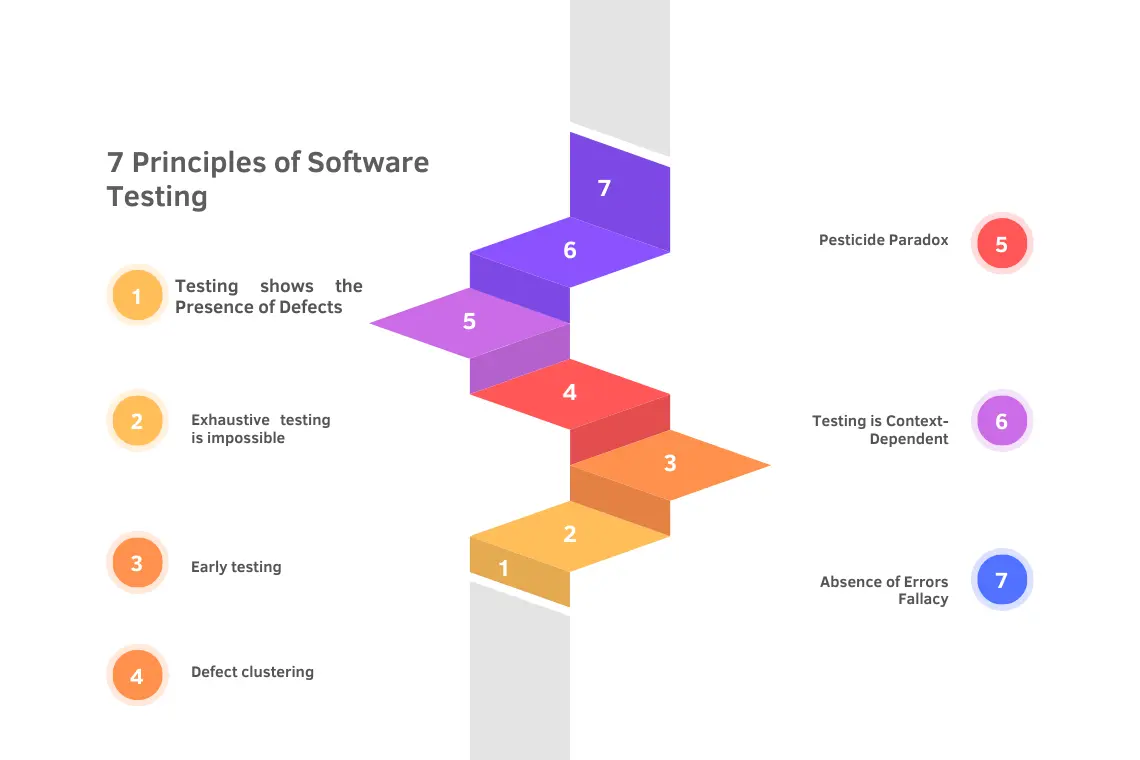
- 1. Testing Shows Defects: Testing can show that defects are present but cannot prove that there are no defects.
- 2. Exhaustive Testing is Impossible: Comprehensive testing of all input combinations and preconditions is not feasible. Prioritization based on risks is essential.
- 3. Early Testing Saves Time and Money: Testing activities in the software development lifecycle should begin as early as possible.
- 4. Defect Clustering: A small number of modules often contain most of the defects.
- 5. Pesticide Paradox: Repeated use of the same test cases eventually ceases to find new defects. Test cases need regular review and updates.
- 6. Testing is Context Dependent: Testing approaches vary depending on the context, such as safety-critical systems versus e-commerce applications.
- 7. Absence-of-Error Fallacy: The absence of detected defects does not guarantee the software fulfills users’ needs and expectations.
Fundamental Test Processes
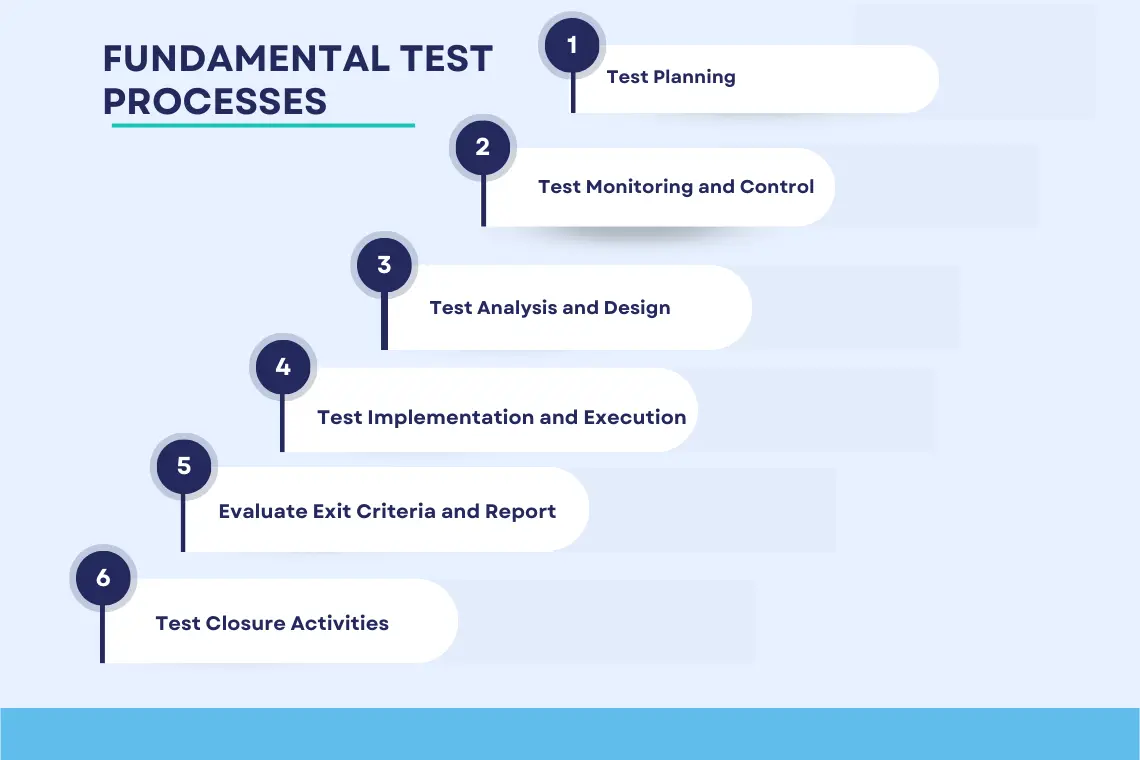
- 1. Test Planning: Define scope, objectives, and risk analyses. Allocate resources and schedule activities.
- 2. Test Monitoring and Control: Adjust plans based on new information and challenges.
- 3. Test Analysis and Design: Develop test conditions, cases, environments, and data.
- 4. Test Implementation and Execution: Prioritize, prepare, and execute test scripts, then report incidents and outcomes.
- 5. Evaluate Exit Criteria and Report: Assess whether the team has met the objectives and requires additional tests.
- 6. Test Closure Activities: Document and archive test assets for future use.
Test Planning, Monitoring, and Control
A comprehensive test plan details what, how, when, and by whom the team will conduct the testing. The team includes the scope, objectives, risk analyses, test levels and types, documentation to be produced, resource assignments, and the scheduling of implementation, execution, and evaluation in the test plan. We should control and adjust the plans to reflect new information and challenges.
Analysis and Design
Reviewing the test basis involves understanding requirements, product architecture, design, interfaces, and risk analysis reports. Testers then transform general test objectives into specific test conditions. The design phase includes creating test cases, environments, and data, ensuring traceability throughout.
Implementation and Execution
Testers group and prioritize tests into scripts. In this stage, we prepare test oracles and write automated test scenarios. Execution involves running the tests, comparing results with oracles, reporting incidents, repeating activities for corrected discrepancies, and logging outcomes.
Evaluate and Report
Evaluating test execution against defined objectives helps us determine if we need more tests or if we should change the exit criteria. A summary report detailing the results and findings is prepared for stakeholders.
Test Closure Activities
Test closure involves making test assets available for future use and documenting the testing process. This preservation ensures that valuable insights and data are available for subsequent projects.
The Psychology of Testing
A successful tester exhibits curiosity, professional pessimism, attention to detail, strong communication skills, and experience in error guessing. Effective testers communicate defects and failures constructively, ensuring clear understanding and actionable feedback.
Independence in testing enhances defect detection. Depending on the objectives, the same developer, a different team member, a separate testing team, or an external organization can perform testing.
Conclusion
Understanding and implementing software testing fundamentals is an indispensable part of software development, ensuring that systems function correctly and meet user needs.
Organizations can significantly improve their software quality and reliability by adhering to test principles, understanding the causes of defects, and following structured test processes.
Embracing a thorough and well-planned software testing fundamentals strategy ultimately leads to better software products and a more satisfied user base.
🚀 Before You Go:
- 👏 Found this guide helpful? Give it a like!
- 💬 Got thoughts? Share your insights!
- 📤 Know someone who needs this? Share the post!
- 🌟 Your support keeps us going!
💻 Level up with the latest tech trends, tutorials, and tips - Straight to your inbox – no fluff, just value!





Merely wanna input on few general things, The website style is perfect, the subject matter is really great. “To establish oneself in the world, one has to do all one can to appear established.” by Francois de La Rochefoucauld.