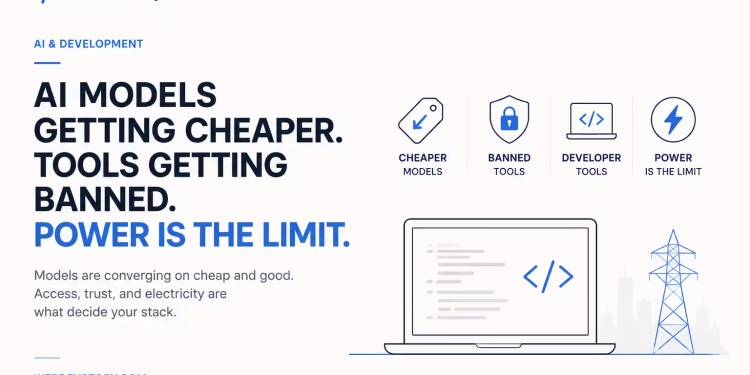
Somewhere along the way, AI stopped being a benchmark contest and became a question of who is actually allowed to run the thing. Coding agents are getting banned across borders. Open weights are undercutting the frontier labs on price. And the real ceiling on all of it is turning out to be electricity, not intelligence.
For a long stretch, the only question anyone asked about a new model was whether it topped the leaderboard. That question has quietly gotten less interesting. Alibaba told its own engineers to stop using a leading coding agent. A model out of China, released under an open license, posted coding scores above GPT-5.5 for a fraction of the price. A security team showed that a popular AI editor could be talked into running commands on the developer’s own laptop. String those together and a pattern shows up that has nothing to do with capability. What decides your stack is no longer which model is smartest. It is cost, trust, access, and physics.
None of these stories is really about which model is smartest, which is why lining them up as a ranked list would miss the point. So this piece follows the thread instead: the models, then the tools built on them, then the money and machines underneath, then the regulation tightening around the whole thing. It closes where a builder audience needs it to close, with the work this actually creates and a short list of things worth doing about it. If you have been following our reporting on AI coding agents moving into developer desktops, most of this will feel like the next chapter.
Table of Contents
The models are getting cheap, fast
One of the clearest signals arrived looking like a boring product update. OpenAI started previewing three new models for developers: Sol, the top-end reasoning and long-horizon agentic one; Terra, which it pitches as GPT-5.5-competitive at roughly half the cost; and Luna, the fast, cheap option. Everyone fixates on the flagship. Terra is the one that changes your budget. When a GPT-5.5-class model shows up at half the price, it drags the whole price floor down with it, and any cost model built on the old numbers goes stale overnight.
Anthropic made the point from the other direction by making Claude Sonnet 5 the default for Free and Pro users at a mid-tier price while it performs close to flagship Opus 4.8 on a lot of tasks. Read that back slowly, because it is the new baseline: near-flagship quality, mid-tier price, switched on by default. Your users’ idea of what “has AI features” means just moved, and you did not ship anything to cause it.
The sharpest example, though, came from neither big lab. Z.ai’s GLM-5.2 is a 744-billion-parameter model, about 40 billion active per token, with a one-million-token context window, released under a permissive MIT license you can host yourself. On Z.ai’s own benchmarks it scores 62.1 on SWE-bench Pro against GPT-5.5’s 58.6, and it lands within a point of Claude Opus 4.8 on long-horizon coding (Z.ai developer docs).
Two things are worth saying plainly here, because the hype tends to skip them. Those are Z.ai’s own numbers, and independent evaluators have not fully replicated them yet. And “self-host it” is doing a lot of heavy lifting in that sentence. The full-precision model wants server-class GPUs; a quantized build will run on a beefy workstation, but slowly. The weights are free. The hardware to run them is emphatically not. This is the same tension we dug into when we asked how developers stay valuable as they shift toward agentic engineering: the tooling keeps getting cheaper and more available, but knowing what to run and where still pays.
The moat was never really the model. It is what you build around it: how cheaply you serve it, how well you integrate it, how fast you can swap it out.
Put the pieces side by side and the direction is hard to miss. Raw access to a good model is turning into a commodity, and the value is sliding toward serving efficiency, cost, and integration. The price cuts coming out of the big labs are defensive, not generous. The thing to watch for is the first company that goes on record saying it moved a real production workload off a proprietary API onto a self-hosted open model, with the bill attached. Put a name and a number on that, and “open weights are production-ready” stops being a talking point.
The tools built on those models are pulling apart
Here is the twist. The models are converging on cheap and good, but the coding tools sitting on top of them are splitting apart, and not over anything as tidy as quality. The fault line is access.
Alibaba banned its staff from using Anthropic’s Claude Code, pointing at China-identification and backdoor concerns. Around the same time, Anthropic moved to shut the side doors that had let Chinese firms reach Claude through overseas subsidiaries and cloud routing. Same story, told from both ends: an AI coding tool is now a supply-chain asset with a passport, and whether you can use one has become a compliance question rather than a line item. Standardize your team on a single frontier agent and you have quietly taken on a dependency that a policy decision somewhere else can switch off. We saw the early shape of this when we wrote about AI coding going mainstream and developer pipelines turning into a security battleground.
Z.ai walked straight into that opening with ZCode, a coding tool aimed at Cursor and GitHub Copilot on price. Bundle it with GLM-5.2’s open weights and the whole category reframes. The argument developers had all year, which agent is smartest, is quietly turning into a different one: which tool is cheap, trusted, portable, and allowed. Anyone who priced purely on capability is now in a margin fight, and the tell will be Cursor, Copilot, or Claude Code adjusting their pricing without much fanfare.
“Which coding agent is smartest?” is turning into “which one is cheap, trusted, portable, and allowed?” Every one of those four words is now a business risk, not a preference.
Your AI editor is now something an attacker can reach
This is the story small teams most need to get right, and the one that is easiest to overstate. A team at Cato Networks disclosed two critical flaws in the Cursor AI editor, together named DuneSlide and tracked as CVE-2026-50548 and CVE-2026-50549, both rated CVSS 9.8. In plain terms: a prompt injection can break out of Cursor’s command sandbox and run code on the developer’s machine, off the back of a single harmless-looking prompt. The malicious instructions never come from you. They ride in on something the agent reads for you, like an MCP server response or a web search result (SecurityWeek, The Hacker News).
Now breathe, because here is the part the scary headline leaves out: it is already fixed. Both flaws were patched in Cursor 3.0, released in April 2026. Every version before 3.0 is exposed, and there is no sign anyone exploited this in the wild. So the job is a version check, not a fire drill.
The lesson, though, sticks around longer than the patch. Cato says it is finding the same class of sandbox-escape bug in other coding agents and thinks the weakness is structural rather than a Cursor-specific slip. Any tool that lets an agent go fetch outside content is a possible way in. That is the real takeaway if you run agentic editors: treat everything the agent reads as hostile until proven otherwise. If you connect these tools to WordPress or WooCommerce through MCP, our practical guide to wiring AI assistants into WordPress with MCP walks through the permission boundaries that matter, and DuneSlide is a good reason to revisit them. For the wider picture, our overview of common web application security vulnerabilities and how to mitigate them still holds up.
Get everyone onto version 3.0 or later, since anything older carries the DuneSlide flaws. And as a standing habit, do not hand any AI coding agent your production credentials or secrets, and stay picky about which MCP servers and web sources it is allowed to read.
Follow the money and you end up at power and memory
The capital moving through the ecosystem tells the infrastructure side of the story, and it is a strange one. Together AI raised roughly $800M at an $8.3B valuation, close to doubling its worth, on bookings north of $1.15B a year, with more than 500 megawatts of compute locked in. When a company built on other people’s models crosses a billion in bookings, the lesson writes itself: in open-source AI, the durable business is operations and cost, not owning the model. Infrastructure wins on margins.
That record H1 buries its most telling detail in the second figure. Two labs took nearly half of it. Money is flooding in, but it is pooling in a few places, and the more interesting raises are the ones that have nothing to do with models. Etched pulled in $800M for purpose-built AI silicon, a reminder that inference chips still attract real money as a lever on the GPU cost curve. Bloom Energy and Brookfield stretched their AI power financing to $25B. Valar Atomics teamed up with Nvidia on a nuclear-powered, water-sipping data center. Three deals, one message: the money behind AI has moved from chips and models to the electricity that feeds them. Turns out the compute shortage was an energy shortage wearing a costume.
Nvidia said the quiet part out loud with its own supply chain, signing a multiyear deal with SK hynix South Korea to co-develop next-generation memory, with SK hynix also picking up Nvidia’s tooling for chip simulation. Memory, not logic, is where the current bottleneck sits, and locking in supply this far ahead tells you Nvidia expects demand to keep outrunning capacity deep into 2027. If you rent compute, plan for GPU scarcity and cloud pricing pressure to stick around.
Others are betting the opposite way. Qualcomm showed off data-center chips that skip high-bandwidth memory entirely, an approach that could take some of the sting out of inference hardware costs if it pans out, which is the part of the stack most of us actually touch. And AMD put £2 billion into UK AI supercomputing after a strong run, which finally makes a credible second GPU supplier feel real. More competition on silicon means more options and more room to negotiate for anyone renting.
Not everything was infrastructure. Quantum Systems Germany raised $1.2B, the largest private defense-tech round in European history, on the back of drones that flew 19,000 combat missions in Ukraine in a single year. European defense tech has become a top-tier venture category, and hardware that has actually been used in the field commands a premium. Over in India India, Bhavin Turakhia is putting $30M of his own money into Neo, an AI-native office suite built on the belief that you cannot just bolt a chatbot onto pre-AI workplace software and call it done. “Rebuild the category from scratch, AI-native” is the founder pitch of the year, and a proven operator funding it himself rather than raising is a loud vote of confidence that the incumbents are more vulnerable than they look.
Regulation and the physical world catch up
The infrastructure story does not stay on a balance sheet. It runs into permits, water, and courts, and a cluster of recent signals shows AI’s physical and legal footprint becoming a real cost input.
Take the physical side first. AI data centers use more water than a lot of tech companies admit once you count the indirect use, and the growing pressure on power and water is going to shape both cloud costs and whether new sites get approved. Seen through that lens, Valar Atomics’ water-sipping nuclear plan looks less like a green press release and more like a siting strategy. The thing to watch is the first formal reporting or permitting rule tied to AI energy and water use. Once that lands, sustainability turns from a disclosure debate into a hard limit on where capacity can go and what it costs to rent.
Then the legal side. Google’s €4.1B EU Android fine EU became permanent this month after a final appeal failed, closing the book on the pre-install bundling case for Search and Chrome, and opening a path for rivals to claim damages. Default-placement and exclusivity deals are now genuinely risky in the EU. If your distribution leans on being the pre-installed option, expect scrutiny, and expect more of those default-choice screens that indie apps can actually win a slot on.
On AI specifically, the tempo is picking up, and this one comes with a date you can circle. The EU AI Act’s transparency rules apply from 2 August 2026 EU, confirmed by the European Commission. They cover telling users when they are dealing with an AI system and labeling AI-generated content. The tougher high-risk rules, covering areas like biometrics, critical infrastructure, employment, and migration, got pushed to December 2027 under the “AI omnibus” deal, but the transparency piece holds for August 2026 (European Commission). If you serve EU users, that transparency deadline is a real date to build toward, not a vague someday.
One nuance that actually helps developers: the Commission’s draft guidance suggests the disclosure duty can be lighter where the AI is obviously AI, and it specifically names a code assistant used only by professional developers as an example (Article 50 guide). Consumer chatbots and any AI-generated media are where the real weight of the rule falls. If you build for the Nordics, this pairs directly with the groundwork in what it actually takes to launch a WooCommerce store in Norway, where compliance is already part of the checklist.
Europe is not only writing rules, though. It is shipping. Portugal launched Amalia EU, its first open-source AI model, which drags “sovereign AI” out of the policy deck and into something you can actually deploy, with real value for local-language public services and regulated sectors. Sovereign AI is quietly becoming a procurement line for EU public bodies, and the consulting demand trails right behind it: local-language fine-tuning, EU-hosted deployment, compliance-aware integration.
Two more pieces fill in the map. Microsoft and Singapore’s Lightstorm are leading a consortium building I-2SEA India / APAC, a 3,600 km subsea cable tying India to Malaysia and Singapore, aimed at a late-2029 launch to feed AI, cloud, and data-center demand. It is one more sign India is becoming a first-class cloud region rather than an offshoring afterthought, which opens real products for the domestic Indian market and some cheaper compute arbitrage. And AWS and Google Cloud opened a native multicloud interconnect, plus a cross-cloud lakehouse on Apache Iceberg and caching built to cut egress fees, with Azure expected to follow. The hyperscalers are quietly admitting multicloud is here to stay. Lower egress and query-in-place data mean less lock-in, which helps startups at the negotiating table and opens a fresh consulting lane in cross-cloud cost work, something we get into in our guide to multi-cloud strategies for agility, resilience, and cost. Meta, meanwhile, is spinning up a cloud business to sell off its spare AI compute, turning surplus into a market and adding one more supplier to lean on inference rates.
The other live wire: patch discipline
This one sits apart from the AI thread, but the pattern is worth keeping in mind long after the specific bugs are patched. A pair of actively exploited vulnerabilities showed up close together: CVE-2026-45659, a CVSS 8.8 remote-code-execution flaw in Microsoft SharePoint Server that CISA added to its Known Exploited Vulnerabilities list with a July 4 patch deadline for federal agencies, and a Progress LoadMaster pre-auth RCE, CVE-2026-8037 at CVSS 9.6, that started seeing exploitation soon after (The Hacker News). SharePoint is everywhere in mid-market and government. When something like this surfaces, it is a live incident for anyone doing agency or MSP work, not a maintenance ticket, and the right move is to go audit affected clients immediately rather than wait for a scheduled window. It is also, as the next section notes, immediate paid work for anyone who moves quickly. If you have ever had to clean up after an intrusion, our writeup on recovering and hardening a compromised WordPress VPS covers the mindset.
What to actually do about it
Strip out the geopolitics and the funding rounds and you are left with a short, concrete list. None of it needs a budget. Most of it needs an afternoon.
- Update Cursor to 3.0 or later if you use it, and check that no AI coding agent on your team is holding production credentials or secrets.
- Review your agent permissions on Cursor, Copilot, and Claude Code, especially which MCP servers and web sources each one can read, since that is the way in.
- Add an AI-content disclosure anywhere you publish AI output to EU users, ahead of the 2 August 2026 deadline.
- Re-run your LLM cost numbers against the current cheaper tiers before you lock into any single provider for a year.
- Keep an exit ready. Whether it is an open-weight model like GLM-5.2 or just a second provider, do not build yourself into a vendor you cannot walk away from if the price or the access changes.
Every one of those is also billable. The fuller list below spells out where the demand is sitting.
The work this creates
For developers, freelancers, and agencies
AI-devtool security hardening. DuneSlide turned the agentic editor into an attack surface. Sell a fixed-scope review, covering sandbox config, prompt-injection checks, and permission scoping, to teams already living in Cursor, Codex, or Claude Code.
EU AI Act transparency kits. With the 2 August 2026 transparency deadline on the calendar, build reusable disclosure components, content labeling, and model-documentation templates once, then resell them to every EU-facing SaaS client you have.
Cross-cloud cost optimization. The AWS and Google interconnect and the Iceberg lakehouse make query-in-place and egress cuts newly practical. Package a “cloud bill teardown, then migration” engagement where the egress savings cover your fee. Our comparison of cloud storage across Firebase, AWS, Azure, and Google Drive is a decent starting reference for those conversations.
Open-weight migration and portability. GLM-5.2 and Together AI turn “move this off a proprietary API to self-hosted or neocloud” into a concrete, ROI-backed project, and that portability work doubles as insurance against exactly the access risk Alibaba just demonstrated. Your buyers are seed and Series-A startups feeling the API bill.
Cloudflare AI-crawler configuration. Cloudflare’s new controls block AI training and agent crawlers by default on a lot of sites from mid-September. Every content site and every crawling product needs its bot policy looked at. A clean, repeatable setup plus a monitoring retainer.
Sovereign AI for European SMEs. Amalia and the wider sovereign push open a lane for local-language deployment, EU-hosted integration, and compliance-aware model choices for public-sector and regulated clients.
AI infrastructure cost content and calculators. With compute, energy, and egress all in motion, cost-comparison tools and teardown posts are a low-competition way to catch builder search intent and feed your own pipeline. If you go this route, our take on generative engine optimization is worth a look, since that is increasingly how this kind of content gets found.
Three you can start solo, this week or any week
A patch-and-audit sprint for local SMBs and councils. A one-to-two-day emergency assessment against whatever CVEs are under active exploitation, the SharePoint and LoadMaster flaws being the current example. Your buyers are small businesses, law firms, and local government running on-prem software with nobody on security. The timing is the whole pitch: when CISA sets a federal patch deadline and the exploits are already live, non-federal orgs have no one telling them to move. No upfront cost, urgent demand, a checklist you can reuse every time the next serious CVE lands.
An AI image pipeline for marketing teams. Wire Google’s cheap Flash image model into a client’s content workflow, with branded templates, batch generation, and an approval screen. Your buyers are small e-commerce brands and local agencies buried in creative requests. The low token pricing means you can quote a flat monthly fee and still make money. No enterprise contract, no GPU purchase, just some API glue and a simple front end.
An AI coding-tool audit for small dev teams. A straight comparison of Claude Code, Copilot, Cursor, ZCode, and the open agents across cost, portability, security, and whether they are even allowed in the client’s jurisdiction, plus a cleanup pass for founders who built with vibe-coding tools and now need auth, tests, security, and deployment sorted out. Your buyers are small teams and solo founders trying to settle on a toolchain. The Alibaba ban and ZCode’s price attack turned “which tool is cheap, trusted, portable, and allowed?” into a decision people have to make, not a debate they can put off.
Market mood
Talent is splitting hard. AI-infrastructure and defense-tech engineers are in a seller’s market, while generalist roles feel the squeeze as agentic tooling trims headcount. The skill combination that pays is AI coding plus security, cloud deployment, and cost control. Being good at one of those is no longer enough to stand out. It is the same argument we keep making about the developer skills that do not go out of date.
VC appetite is hot but fussy. A record H1 sits next to a clear demand for differentiation, traction, low burn, and real IP. Money still prefers infrastructure to thin wrappers, and the generic AI wrapper is basically unfundable now.
The developer conversation is landing on two ideas that feed each other. Self-hosting a frontier-class coder is finally realistic, thanks to GLM-5.2’s license and scores. And “which agent is smartest?” is becoming “which one is cheap, trusted, portable, and allowed?” Both point the same way, away from raw capability and toward control.
On the radar next
Five things worth watching, each one a sign that these shifts are hardening into something lasting rather than fading into a passing news cycle.
Open-source worth bookmarking
The thread running through all of it is control. Capable models are not the scarce thing anymore; they are everywhere, and getting cheaper. What is scarce is being able to run the tool you want, at a price you can forecast, on terms you are actually allowed to accept, without handing an autonomous agent the keys to your machine. That is the axis worth building on. For the bigger strategic picture of where the developer stack is heading, our piece on how the AI developer stack is being reshaped in 2026 zooms out from the moment.
Sources include Z.ai’s developer docs, the European Commission, and Cato Networks via SecurityWeek and The Hacker News, alongside vendor announcements. Figures reflect what was published at the time of writing. Benchmark claims noted as self-reported have not yet been fully replicated by independent evaluators, and some funding and pricing details come from secondary reporting rather than primary filings.
🚀 Before You Go:
- 👏 Found this guide helpful? Give it a like!
- 💬 Got thoughts? Share your insights!
- 📤 Know someone who needs this? Share the post!
- 🌟 Your support keeps us going!
💻 Level up with the latest tech trends, tutorials, and tips - Straight to your inbox – no fluff, just value!